
Why Operational Leaders Are Standardizing on Unified Command Centers
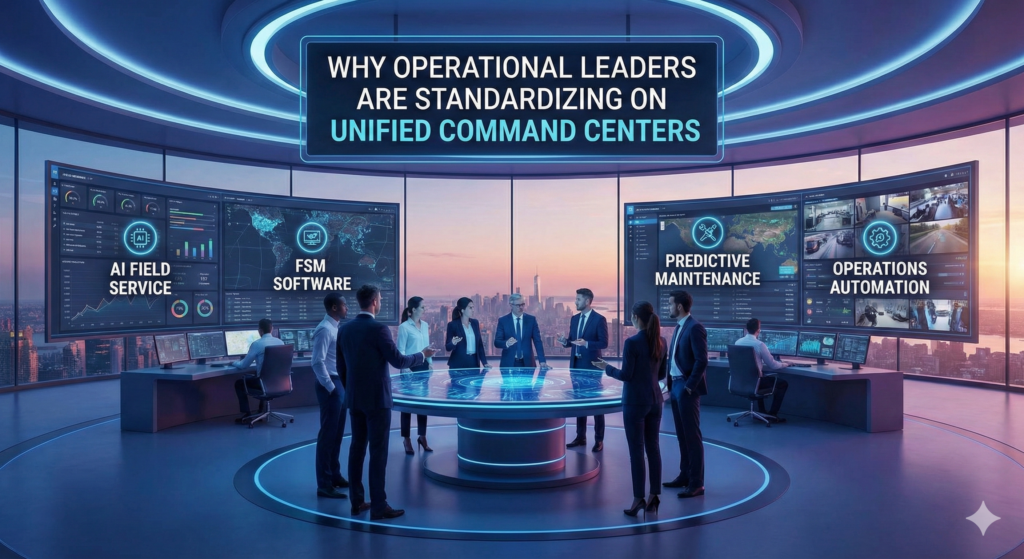
The modern enterprise operates in an environment where operational complexity has reached unprecedented levels. Field service organizations managing distributed teams, mobile assets, and customer commitments across multiple geographies face a persistent challenge: visibility without actionability creates operational blind spots that erode efficiency and customer satisfaction. This reality has driven forward-thinking operational leaders to abandon fragmented systems in favor of unified command centers that consolidate data, automate decisions, and provide real-time intelligence across the entire service ecosystem.
The Breaking Point: When Fragmentation Becomes a Liability
Enterprises typically reach a critical juncture when their operational infrastructure can no longer support growth trajectories or customer expectations. Organizations managing field operations through disparate systems – separate platforms for scheduling, inventory management, customer communications, and technician dispatch – experience what industry analysts describe as the “integration tax.” This tax manifests as duplicated data entry, conflicting information across departments, delayed response times, and ultimately, revenue leakage that compounds quarterly.
The financial impact of operational fragmentation extends beyond immediate inefficiencies. Research from Aberdeen Group indicates that organizations operating without unified platforms experience 31% longer mean time to repair compared to those using integrated systems. When technicians arrive on-site without complete asset histories, when dispatchers lack visibility into real-time technician locations, or when parts inventory exists in siloed databases disconnected from work order systems, every service interaction becomes an exercise in improvisation rather than execution.
Customer tolerance for these operational shortcomings has diminished dramatically. The expectation for Amazon-level service transparency has migrated from retail into every sector, including industrial services, healthcare equipment maintenance, telecommunications infrastructure, and facilities management. Customers now expect accurate arrival windows, proactive service notifications, and first-time fix rates that fragmented operational systems simply cannot deliver consistently.
The Architecture of Unified Intelligence
Unified command centers represent a fundamental reimagining of how operational data flows through an organization. Rather than forcing managers to toggle between multiple applications to understand workforce utilization, asset performance, or customer satisfaction trends, these platforms consolidate operational intelligence into a single source of truth. The architectural principle underlying modern FSM software centers on breaking down information silos while maintaining the specialized functionality that different operational roles require.
The practical implementation of this architecture manifests in several critical capabilities. Real-time visibility across the entire service network allows operations managers to monitor technician locations, job statuses, and resource availability through unified dashboards that update continuously. When a high-priority customer issue emerges, dispatchers can immediately identify the nearest qualified technician with appropriate inventory and reroute them without manual phone calls or system-hopping. This capability alone typically reduces emergency response times by 40% to 60% in organizations that transition from fragmented to unified platforms.
Intelligent automation represents the second pillar of unified command centers. Modern AI field service platforms don’t simply display information; they actively optimize operations through machine learning algorithms that improve with every completed job. Automated scheduling engines consider dozens of variables simultaneously including technician skills, geographic proximity, traffic patterns, parts availability, customer preferences, and service level agreements to generate optimal daily routes that human dispatchers could never replicate manually. Organizations implementing these systems report immediate improvements in daily job completion rates, often seeing increases of 15% to 25% in technician productivity within the first quarter of deployment.
Predictive Intelligence: From Reactive to Proactive Operations
The transformation from reactive service delivery to proactive maintenance represents perhaps the most significant value proposition of unified command centers. Traditional field service operates on a break-fix model where organizations respond to equipment failures after they occur. This approach generates unnecessary emergency service calls, creates unpredictable workforce demand, and ultimately costs enterprises substantially more than planned maintenance interventions.
Predictive maintenance capabilities embedded within unified platforms analyze equipment performance data, historical failure patterns, and environmental conditions to forecast potential issues before they result in downtime. IoT sensors streaming data from connected assets feed machine learning models that identify anomalies indicating imminent failures. When these systems detect degraded performance signatures in critical equipment, they automatically generate preventive work orders, assign appropriate technicians, and ensure necessary parts are available before the asset fails completely.
The financial implications of this shift are substantial. Deloitte research demonstrates that predictive maintenance strategies reduce maintenance costs by 20% to 25% while decreasing unplanned downtime by up to 50%. For organizations operating mission-critical infrastructure in healthcare, manufacturing, or energy sectors, the avoidance of catastrophic equipment failures delivers returns that justify platform investments within months rather than years.
Measurable Returns: The Economics of Unified Operations
Operational leaders adopting unified command centers consistently report quantifiable improvements across multiple performance dimensions. First-time fix rates typically improve by 20% to 35% as technicians arrive with complete asset histories, correct parts, and detailed service protocols accessed through mobile applications connected to the unified platform. This improvement directly impacts customer satisfaction scores while reducing costly return visits that erode profitability.
Workforce utilization metrics demonstrate equally compelling gains. Organizations leveraging operations automation through unified platforms report technicians completing an average of two to three additional service calls daily compared to previous manual dispatch methods. This productivity enhancement doesn’t require hiring additional staff or extending work hours; it simply eliminates the inefficiencies inherent in fragmented systems where technicians spend excessive time searching for information, waiting for parts, or traveling inefficient routes.
Customer experience metrics provide the ultimate validation of unified command center effectiveness. Net Promoter Scores in organizations that implement these platforms typically increase by 15 to 30 points as customers benefit from accurate service windows, proactive communication, and higher first-time resolution rates. In competitive markets where service quality differentiates otherwise similar offerings, these customer experience improvements translate directly into retention rates and revenue growth.
Implementation Strategies for Enterprise Scale
Successful deployments of unified command centers follow consistent patterns that operational leaders can replicate. Rather than attempting enterprise-wide transformations simultaneously, leading organizations adopt phased approaches that demonstrate value quickly while building organizational confidence. Pilot programs focusing on specific service lines, geographic regions, or customer segments allow teams to validate platform capabilities, refine workflows, and develop internal expertise before broader rollouts.
Integration architecture represents a critical success factor that organizations frequently underestimate. Unified command centers must connect seamlessly with existing enterprise systems including ERP platforms, CRM databases, inventory management systems, and financial applications. The most successful implementations prioritize integration capabilities during vendor selection, ensuring that platforms offer pre-built connectors for commonly used enterprise applications alongside robust APIs for custom integrations.
Change management emerges as the differentiating factor between deployments that achieve projected returns versus those that stall. Technicians, dispatchers, and managers must understand not only how to use new systems but why unified platforms benefit their daily work. Organizations that invest in comprehensive training programs, create internal champions, and continuously communicate early wins generate adoption rates exceeding 90% within the first quarter. Those that treat implementation as purely technical exercises frequently struggle with user resistance that undermines potential benefits.
The Competitive Imperative
The transition to unified command centers has evolved from competitive advantage to competitive necessity. Organizations continuing to operate through fragmented systems face mounting disadvantages as customers, employees, and partners increasingly expect the service levels that only unified platforms can deliver consistently. The question for operational leaders is no longer whether to standardize on unified command centers, but how quickly they can execute the transformation before competitive positioning erodes irreversibly.
Forward-thinking enterprises recognize that operational excellence in field service now requires the same technological sophistication that transformed other business functions over the past decade. Just as marketing evolved beyond spreadsheets to marketing automation platforms and sales moved from Rolodexes to CRM systems, field service operations are standardizing on unified command centers that make fragmented approaches obsolete. Organizations embracing this reality position themselves to capture the operational efficiencies, customer satisfaction improvements, and competitive advantages that define market leaders in the next decade of enterprise service delivery.
The path forward demands decisive action from operational leaders willing to challenge legacy approaches and invest in platforms that unify, automate, and optimize field service operations. Those who act decisively will reap measurable returns in productivity, customer loyalty, and profitability. Those who delay will find themselves perpetually playing catch-up to competitors already operating from unified command centers designed for the complexity of modern enterprise service delivery.
Ready to transform your field operations with a unified command center? Discover how FieldEZ delivers AI-powered field service management that increases productivity, reduces costs, and elevates customer satisfaction. Schedule a demonstration today.
References
- Aberdeen Group. (2024). “Service Management Benchmarking Report: The Impact of Unified Platforms on Service Delivery Metrics.” Available at: https://www.aberdeen.com/techpro-essentials/service-management-benchmarking-report/
- Deloitte Insights. (2024). “Using Predictive Technologies for Asset Maintenance: Industry 4.0 Implementation Strategies.” Available at: https://www2.deloitte.com/us/en/insights/focus/industry-4-0/using-predictive-technologies-for-asset-maintenance.html
- FieldEZ. (2025). “AI-Powered Field Service Management Solutions.” Available at: https://fieldez.com/
- FieldEZ. (2025). “Platform Features: Unified Command Center Capabilities.” Available at: https://fieldez.com/features/
- FieldEZ. (2025). “Enterprise Integrations for Seamless Operations.” Available at: https://fieldez.com/integrations/
- FieldEZ. (2025). “Field Service Insights and Industry Trends.” Available at: https://fieldez.com/blog/
