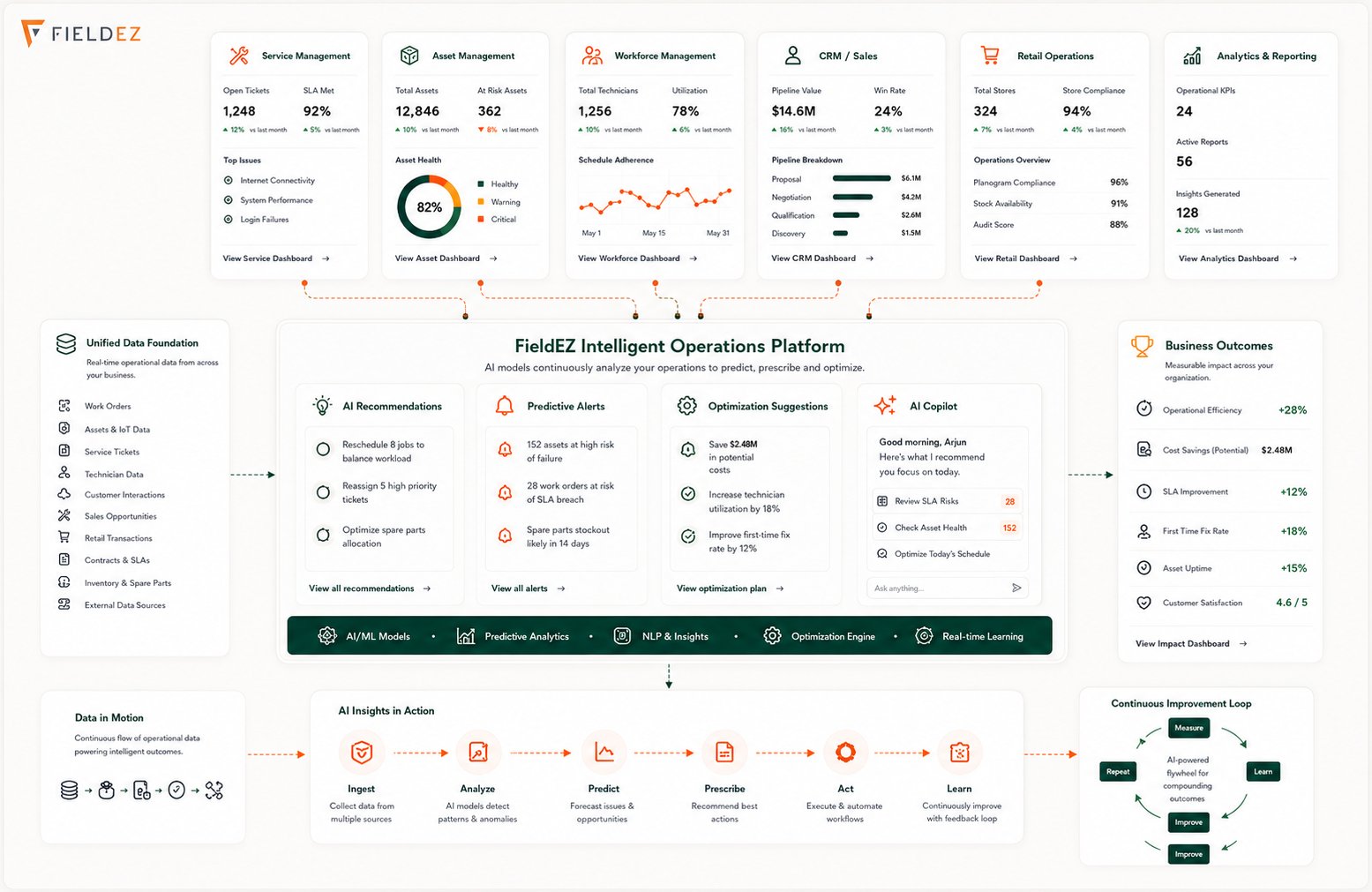
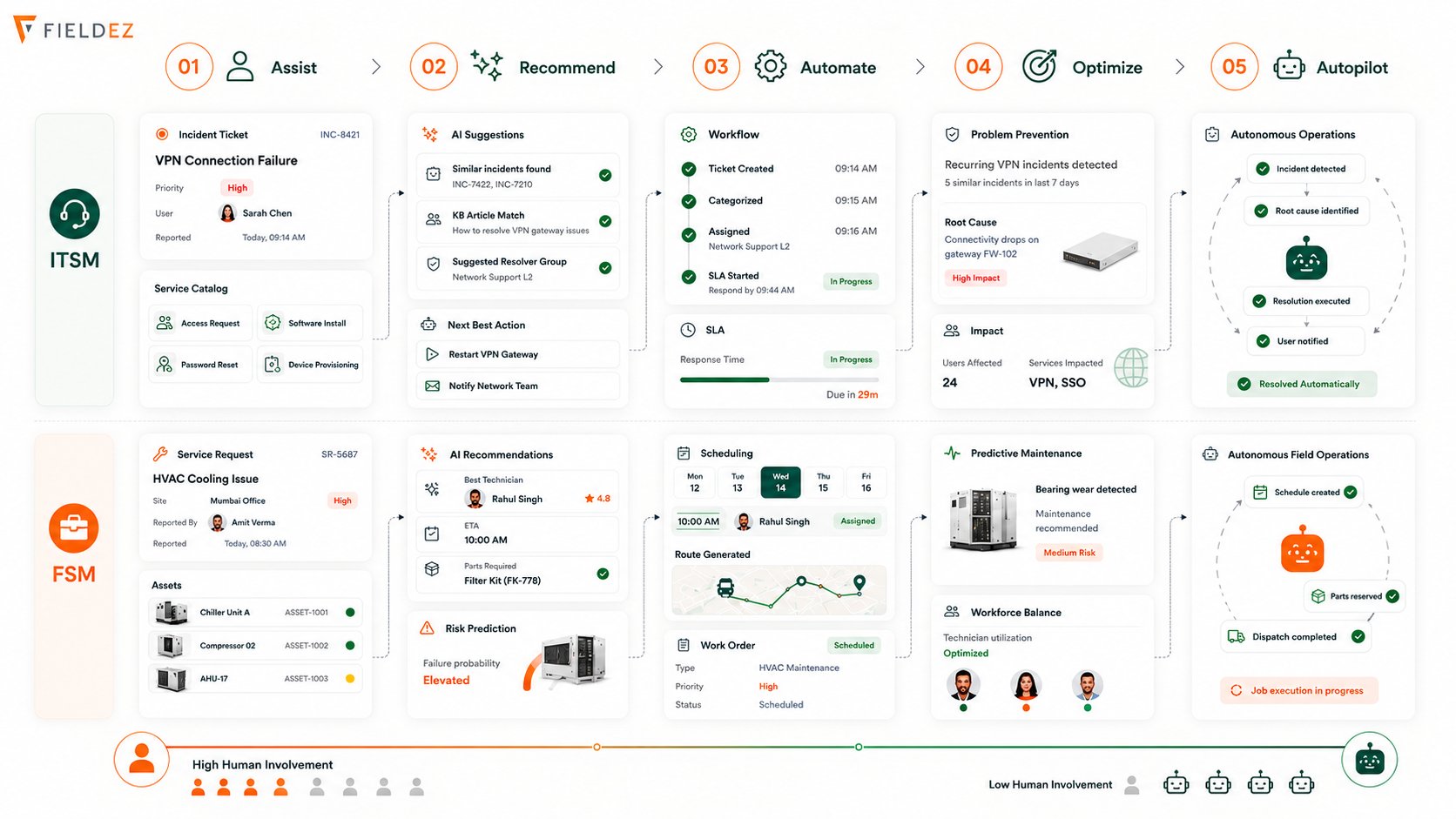
Built on fifteen years of operational data and 50M+ managed assets, FieldEZ AI predicts issues, automates decisions, and optimizes resources — moving operations from human-assisted to autonomous, step by step.

For fifteen years, FieldEZ has captured every service event, work order, asset history, technician action, and SLA outcome across enterprise operations. That operational memory is what turns AI from a chatbot into a system that can make reliable decisions.
A capable model with no memory of your operations — fluent, but guessing. It can sound right without being right, because it has never seen how your equipment actually fails and gets fixed.
Plausible.The same models, grounded in fifteen years of real service history across 50M+ managed assets — what broke, what fixed it, how long it took, which part was needed.
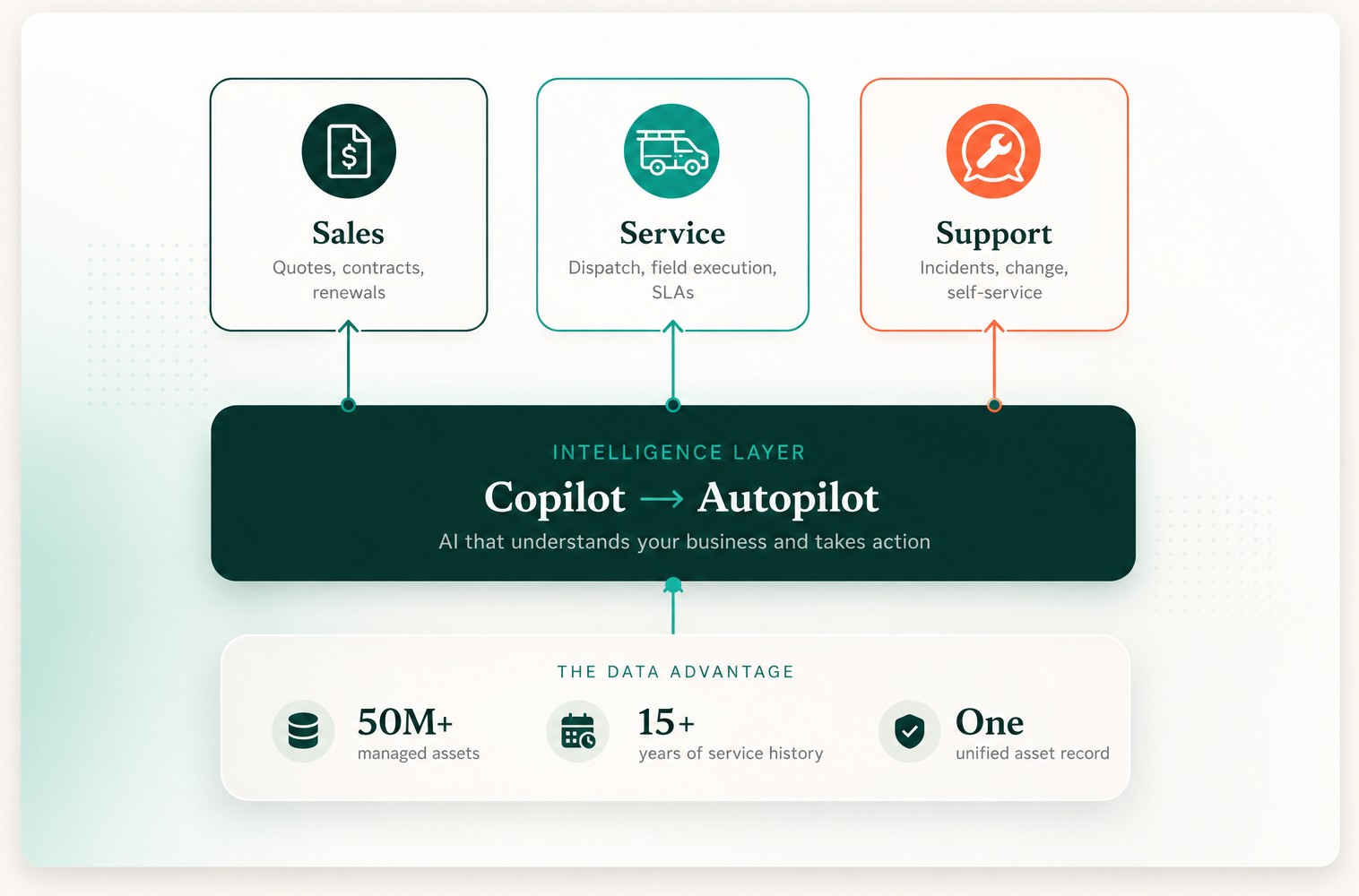
Accurate.Most vendors apply AI to a single workflow. Because Sales, Service, and Support share one asset record, FieldEZ applies it across the whole lifecycle.
Working intelligence across live operations — taking real work off your team's plate now, not in a roadmap slide.
Automatically summarizes work performed, parts used, actions taken, and next steps — cutting the admin tail on every job.
Predicts SLA breaches before they happen and recommends corrective action early enough to act.
Assigns the right technician by skill, location, workload, and SLA priority — without a dispatcher touching every job.
Recommends the parts a job will need before dispatch, and forecasts future demand from asset history.
Surfaces churn risk, renewal opportunities, and customer sentiment from the operational record.
Surfaces the right SOPs, manuals, and historical resolutions in real time, at the point of work.

Organized the way you run your business, not the way we built our models. Service desk, operations, field, assets, workforce, customers, and vision — every suite draws on the same fifteen years of service history, attached to one unified asset record. And the library is a floor, not a ceiling: new capabilities ship with every release.
Every ticket read, categorized, prioritized, and routed in seconds — trained on how your organization has actually triaged, so it inherits your judgment, not a template.
Fifteen years of resolved incidents searched the moment a ticket lands. The agent sees what worked last time before they've opened the ticket — and nothing gets solved twice.
A forty-message thread becomes five lines: what happened, what was tried, where it stands. Handoffs stop losing context; closure notes write themselves.
The three most likely fixes, suggested at the point of work — each showing its source and its track record. One click copies it into the ticket.
Instead of agents searching the knowledge base, the knowledge base finds them — articles ranked by how often they resolved tickets like this one, not by keyword luck.
When the same fix resolves the same problem enough times, the platform drafts the article — sourced, structured, and queued for human review. A knowledge base that writes itself.
Routine requests answered accurately, 24×7, without extra staffing. Frustrated or urgent customers are never handed to a bot — those escalate straight to a person.
“Show me open P1 tickets in Pune.” “Which SLAs breach in the next two hours?” Ask the platform anything, in plain language — and let it act, not just answer.
An engineer with both hands inside a machine can still update the job, search a manual, or close a work order — by voice. Documentation happens during the work, not after it.
Every open ticket carries a live breach-risk score and a predicted breach time. The whole queue becomes a risk map, worst first — and the SLA conversation shifts from post-mortem to prevention.
A warning without a next step is just anxiety. When breach risk crosses the line, the platform recommends the intervention with the best track record — and one click executes it.
Five tickets about the same symptom across three regions is a pattern no human catches in time. The platform does — flagging the storm while it's still a drizzle.
Recurring incidents are the most expensive tickets you have, because you pay for them repeatedly. Related incidents are clustered into proposed problem records — with the evidence attached.
Every change scored against the history of similar changes: what broke, what rolled back, what sailed through. Review effort goes where the risk actually is.
Probable root causes with confidence scores — built from incident clusters, asset history, and the fixes that permanently worked. Why problems recur, not just that they do.
Nobody builds a dashboard for the problem they haven't imagined. Anomaly detection watches the whole operation and flags what's deviating from its own normal — the unknown unknowns get a pager.
Engineers ranked by skill, proximity, workload, and SLA urgency — recommendation and confidence shown, one click to accept. Assignment quality stops depending on which dispatcher is on shift.
Above a confidence threshold you control, routine jobs assign and dispatch themselves. Your dispatchers stop processing the routine ninety percent and start managing the exceptional ten.
Skills, certifications, parts, travel time, SLA clocks, and customer windows — optimized across the whole board at once. When reality changes mid-day, the schedule re-optimizes instead of unraveling.
Each engineer's day sequenced to cut kilometers and maximize wrench time — re-planned in seconds when a job runs long or a P1 lands.
Before the van leaves, every job carries a first-time-fix probability. At-risk jobs get intervention while it's cheap — repeat visits are the most expensive kind, and this is how you buy fewer of them.
The parts a job will likely consume, predicted from the ticket and the asset's history — and checked against the assigned van. The missing part is the biggest cause of failed first visits; this closes it at dispatch.
Arrival windows built from real drive-times and real job durations — not a hopeful four-hour promise. When an ETA slips, the customer hears it from the platform before they have to ask.
Every job type has a true duration hiding in your history; the platform uses it. Schedules stop collapsing at 2pm — the calendar just stops lying.
Confirmations, on-the-way notices, delay alerts, and completion summaries — sent at every stage without a coordinator lifting a finger. Most service complaints are communication complaints; this removes the cause.
When the job closes, the summary drafts itself — work performed, parts used, recommendations, and the customer-facing version. Engineers approve rather than author.
Every asset scored continuously from its service frequency, failure history, age, and telemetry. The fleet ranked worst-first — so attention and budget flow to the assets that actually need them.
Failure signatures learned from fifteen years of what-broke-and-when, raised as maintenance recommendations before the breakdown. Downtime becomes something you schedule, not something that happens to you.
Beyond “at risk”: the specific failure mode, its probability, and its horizon — compressor within 30 days, 73% confidence. The parts for the predicted failure get staged in advance.
The spec sheet says ten years; the asset's actual duty cycle says otherwise. Life estimated per individual asset — feeding capital planning and the repair-or-replace call with evidence instead of averages.
Every repair cross-checked against warranty and AMC terms — flagging work the manufacturer owes you, and claims expiring unclaimed. For large estates, this is found money, recovered continuously.
Parts demand is a shadow of failure patterns — forecast per part, per region, weeks ahead, from the same models that drive maintenance. Stockouts and dead stock both shrink.
Each asset's cost of staying alive, projected forward. The quiet money pits get named early — and budget conversations get specific.
When cumulative repair cost, failure frequency, and remaining life cross the economic line, replacement is recommended — with the numbers that justify it attached.
The assets that can never go down, ranked by business impact and SLA exposure — so maintenance priority, parts stocking, and response times follow risk, not the queue.
Jobs per day, first-time-fix rate, SLA compliance — normalized for job complexity, so hard jobs don't read as slow engineers. Coaching becomes specific instead of general.
Capability gaps mapped from actual ticket outcomes, not self-reported skill matrices — named per person and per region, with the training recommendation attached.
Rosters that account for predicted demand, skills, certifications, leave, and fairness — generated in minutes. Coverage holes flagged while there's still time to fix them.
How many engineers, with which skills, in which regions, over the coming weeks — forecast from demand trends and contract growth. Hiring decisions get a forecast instead of a scramble.
Who'll be overloaded next week — known this week. Rebalancing happens before the missed SLAs, not in their wreckage.
Overtime is a lagging indicator of a planning failure. Projected forward — which teams, which weeks, driven by what — while rebalancing is still possible.
Every contract monitored for the signals that precede a lapsed renewal — and for revenue leaking out as unbilled, out-of-scope work. At-risk contracts surface months before the renewal date makes it urgent.
A health score per account, combining sentiment from emails and tickets with hard operational signals. Accounts trending toward churn get flagged while a save is still cheap.
Twelve assets not under AMC. Equipment aging toward replacement. The service record is full of expansion signals sales never sees — surfaced, sized, and evidenced.
Each contract carries a renewal probability, updated continuously. The book of business becomes a ranked list: defend these, upsell those, forecast the rest with real numbers.
Service revenue projected from its true drivers — contract base, renewal probabilities, demand trends — rather than last quarter plus a percentage.
Contracts, AMCs, warranties, and invoices read and extracted automatically into the right records. The backlog of paper someone was going to key in someday gets processed today.
Every week, a generated executive summary: SLA performance, fleet health, at-risk accounts, and the anomalies worth a leader's attention. The Monday report nobody had time to compile, compiled.
Serial plates, nameplates, forms, and paperwork read straight from a photo into structured fields — transcription errors gone, and the five minutes of typing with them.
Analog dials and digital displays read from a single photo, validated against the meter's history — an implausible reading gets challenged on the spot.
Photograph the equipment; the record opens itself — history, warranty, open tickets. On estates with worn labels, this is the difference between working and searching.
Field photos assessed for damage, wear, and corrosion — graded consistently instead of by each engineer's personal threshold for “looks fine.”
Assets, parts, and locations resolved instantly to their records. Inventory movements and audits at the speed of a camera shutter.
Before work starts on sensitive equipment, a photo verifies the wrist strap is actually worn — logged as compliance evidence on the work order.
Uniform and safety gear confirmed with a selfie at check-in — automatically, in seconds, with the evidence attached to the job.
Ask to see any of these live — a focused demo on your tickets, your assets, your operation.
One intelligence layer. Three ways to run it.
Every plan spans all seven suites — the difference is what the AI is allowed to do. Essentials assists your people. Pro predicts and recommends. Ultimate acts on its own, under rules you set. Each plan includes everything below it, and every capability is live in production today.
The assistive layer across every screen — tickets read and triaged, threads summarized, answers found, data captured by camera. No process change, value on day one.
Everything in Essentials, plus the full foresight layer — every prediction, score, forecast, and recommendation across operations, field, assets, workforce, and customers. Humans decide; the KPIs move.
Everything in Pro switches from recommend to execute, at confidence thresholds you control — with the Autonomy Console, full audit trails, and the executive intelligence layer on top.
Plans are cumulative — each includes everything in the plan before it. Auto marks capabilities that switch from recommend-mode to autonomous execution in Ultimate. Pricing is tailored to your operation — talk to sales.
Autonomy isn't a switch. The platform earns it stage by stage, as it proves it can be trusted with more.
AI Copilot and AI Operator run in production today; Autonomous Operations expands as trust is earned — and at every stage, you decide what runs automatically and what waits for a human.
Traditional AI answers. Agentic AI acts. FieldEZ runs specialized operational agents that carry out work end to end — across the same asset record the rest of the platform shares.
Books, reschedules, and confirms appointments automatically.
Assigns and reassigns engineers based on real-time conditions.
Predicts demand and manages replenishment across van stock and depots.
Monitors workflows and flags operational and regulatory risks.
Generates operational summaries and executive reports automatically.
These agents coordinate across one asset record — the foundation for autonomous operations.
Anyone can access the same foundation models. What can't be replicated overnight is fifteen years of real-world service history — what broke, what fixed it, how long it took, which part was needed — across 50M+ managed assets, millions of work orders, and real resolution outcomes. That is the data that makes automation accurate instead of plausible.
Every job makes the next one smarter. As the software commoditizes, that advantage compounds.The same operational AI, applied to the equipment each industry runs.
Predict network equipment failures and optimize technician dispatch across distributed sites.
Reduce equipment downtime through predictive maintenance and condition monitoring.
Improve medical equipment uptime and keep compliance evidence current.
Optimize ATM and branch device support — uptime where downtime is measured in minutes.
Predict service disruptions and prioritize field response across far-flung assets.
Improve installation and service experience through intelligent scheduling.
Automation only earns more responsibility when it's safe to give. Ours is built for the controls enterprises require.
You decide what runs automatically and what waits for a person. Autonomy expands as trust is earned, never imposed.
The intelligence is built on your operations to serve your operations — governed, not exposed.
ISO 27001 and SOC 2 certified, with role-based access and multi-geography deployment.
A focused walkthrough mapped to your equipment, your estate, and your workflows.